


Syllabus: GS3/ Economy
Context
- India has undertaken wide-ranging reforms to create a transparent, technology-driven, and trust-based business ecosystem, improving investor confidence and enhancing its global competitiveness.
India’s Progress in Ease of Doing Business
- India improved its rank in the World Bank’s Doing Business Report from 142 in 2014 to 63 in 2019, reflecting significant improvements in the regulatory environment.
- India’s position in the IMD World Competitiveness Ranking improved from 43 in 2021 to 41 in 2025.
- India has consistently been placed in Group A of the World Bank’s GovTech Maturity Index, indicating advanced digital governance capabilities.
- The United Nations E-Government Survey has recognized India’s progress in online public services, digital infrastructure, and technology-enabled governance.
Reforms in Business Entry and Formalisation
- Startup Ecosystem Development: The Startup India initiative has promoted innovation, entrepreneurship, and job creation through financial support, incubation facilities, and regulatory incentives.
- The number of recognised startups increased from 502 in 2016 to more than 2.23 lakh by March 2026.
- Simplification of Company Incorporation: The SPICe+ platform has integrated multiple registrations such as PAN, TAN, GST, EPFO, ESIC, and bank account opening into a single online application.
- MSME Formalisation: The Udyam Registration Portal has enabled paperless and self-declaration-based registration of MSMEs.
Reforms in Land and Property Administration
- The Digital India Land Records Modernisation Programme (DILRMP) has digitised land records and cadastral maps, reducing disputes and improving transparency.
- The Unique Land Parcel Identification Number (ULPIN) has created a unique digital identity for land parcels, enabling accurate land management.
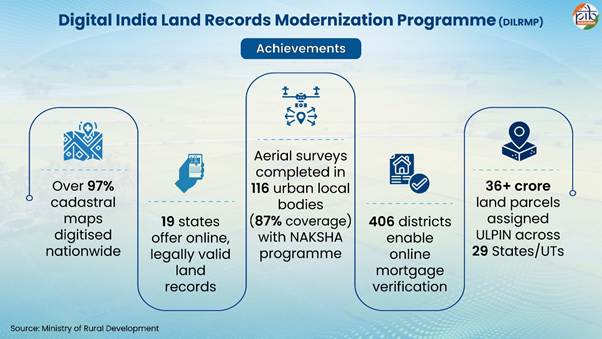
- National Generic Document Registration System (NGDRS) has streamlined property transactions, promoting EoDB by offering a complete user interface for property and document registration.
Streamlining Regulatory Approvals
- Labour Reforms: The Labour Codes have consolidated multiple labour laws into simplified legal frameworks.
- Single registration, single returns, and all-India licences have reduced compliance costs for businesses.
- The National Single Window System (NSWS) provides a unified platform for obtaining approvals and clearances from multiple ministries and states.
- Environmental Clearances: The PARIVESH portal has digitised environmental, forest, wildlife, and coastal regulation clearances.
Improving Market Access and Logistics
- Government e-Marketplace (GeM) has expanded procurement opportunities for MSMEs, startups, women entrepreneurs, and self-help groups through a transparent digital platform. It has promoted inclusive participation in public procurement.
- Open Network for Digital Commerce (ONDC) has created an open and interoperable digital commerce ecosystem that enables small businesses to compete on equal terms with large e-commerce platforms.
- PM GatiShakti has improved multimodal connectivity through integrated infrastructure planning.
Facilitating Access to Credit
- Pradhan Mantri Mudra Yojana: PM Mudra Yojana has expanded financial inclusion by providing collateral-free loans to micro and small enterprises.
- The Credit Assessment Model utilises digital financial data for automated loan appraisal, reducing processing time and improving credit delivery.
- Trade Receivables Discounting System (TReDS) has improved liquidity for MSMEs by enabling faster realisation of payments from corporate buyers and government entities.
Tax Reforms and Compliance Simplification
- Goods and Services Tax (GST): It has replaced multiple indirect taxes with a unified tax structure, creating a common national market.
- It has reduced tax cascading, improved transparency, and facilitated interstate trade.
- The E-Way Bill system has streamlined the movement of goods across states by replacing multiple permits with a single electronic document.
Enhancing Cross-Border Trade
- The Districts as Export Hubs (DEH) initiative aims to promote exports, manufacturing, and employment at the grassroots level.
- ICEGATE (Indian Customs Electronic Gateway) serves as a centralized hub for all electronic interactions between Indian customs and the trading community.
- It offers a range of services including e-filing, online amendment submission, online duty payment, query resolution.
- Trade Connect e-Platform provides comprehensive international trade information and services to all exporters, including MSMEs, enabling them easy access to global markets.
Expanding Digital Public Infrastructure
- Unified Payments Interface (UPI) has transformed digital payments by enabling instant, secure, and low-cost transactions.
- EntityLocker a digital locker for the entities empowers organizations by providing a secure, cloud-based platform for storing, sharing, and verifying digital documents and certificates.
Building a Trust-Based Governance Framework
- Jan Vishwas Reforms have decriminalised hundreds of minor business-related offences. These reforms have reduced the fear of criminal prosecution for procedural violations and encouraged voluntary compliance.
- The Insolvency and Bankruptcy Code (IBC), 2016 established a time-bound framework for insolvency resolution.
- Subsequent amendments have improved procedural efficiency, strengthened creditor rights, and enhanced investor confidence.
Challenges
- Land acquisition and contract enforcement continue to face delays due to disputes, procedural complexities, and judicial backlogs.
- Implementation of reforms varies across States and districts, leading to an uneven business environment.
- Logistics costs remain relatively high compared to competing economies, affecting industrial competitiveness.
- MSMEs continue to face constraints in accessing finance, technology, skilled manpower, and global markets.
- Commercial dispute resolution remains time-consuming, despite improvements in insolvency and regulatory frameworks.
- Global economic uncertainties and supply chain disruptions continue to pose risks to investment and trade growth.
Way Ahead
- Reduce logistics costs by expanding multimodal connectivity, improving warehousing infrastructure, and enhancing last-mile connectivity.
- Enhance MSME competitiveness through easier access to finance, technology adoption, skill development, and integration into global value chains.
- Accelerate land and judicial reforms to ensure faster land acquisition, contract enforcement, and commercial dispute resolution.
- Promote innovation and digital transformation to improve productivity, attract investments, and support India’s transition towards a globally competitive economy.
Source: PIB
Previous article
India’s Cotton Mission and Challenges
Next article
News In Short 08-06-2026
